


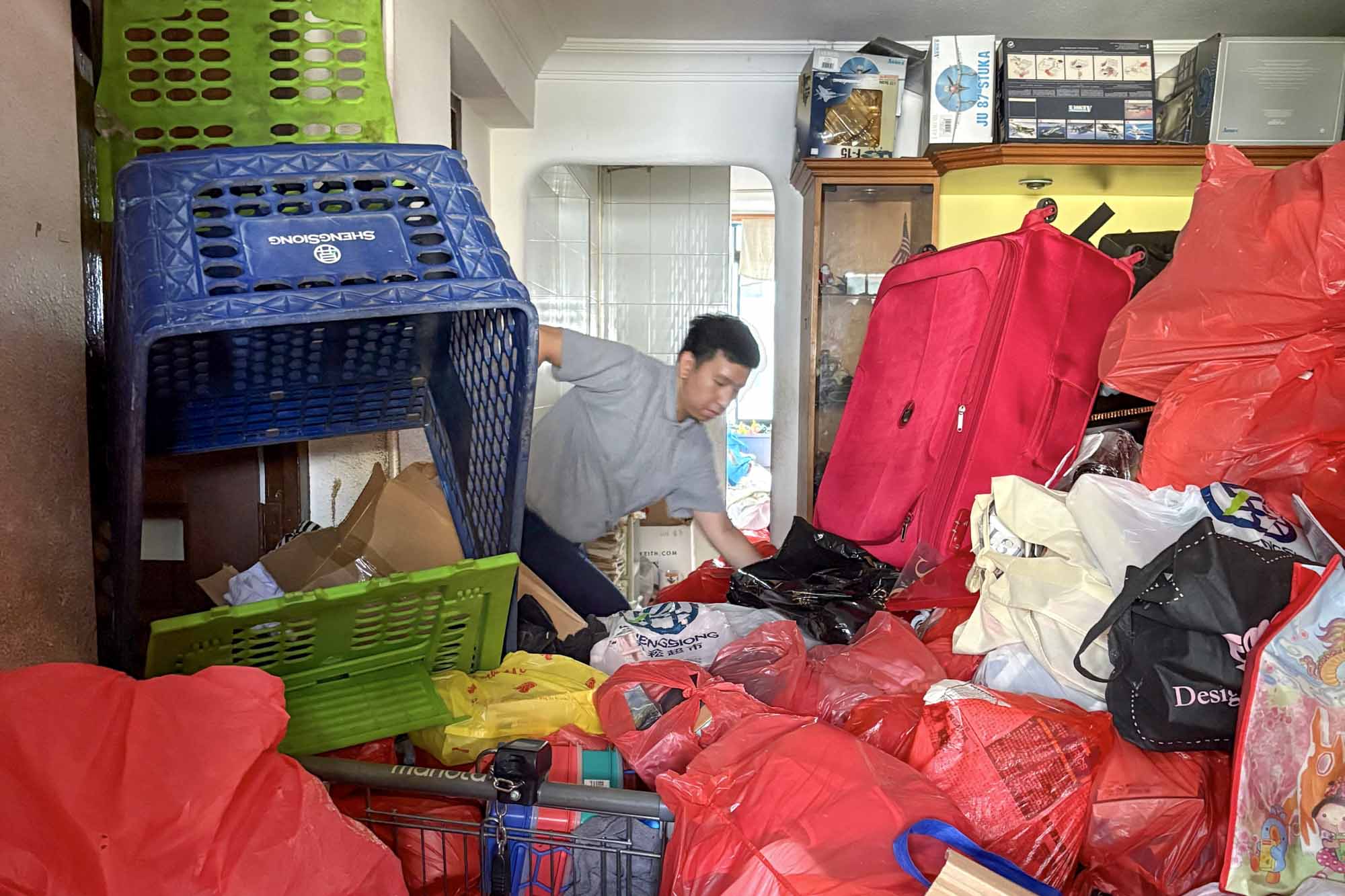
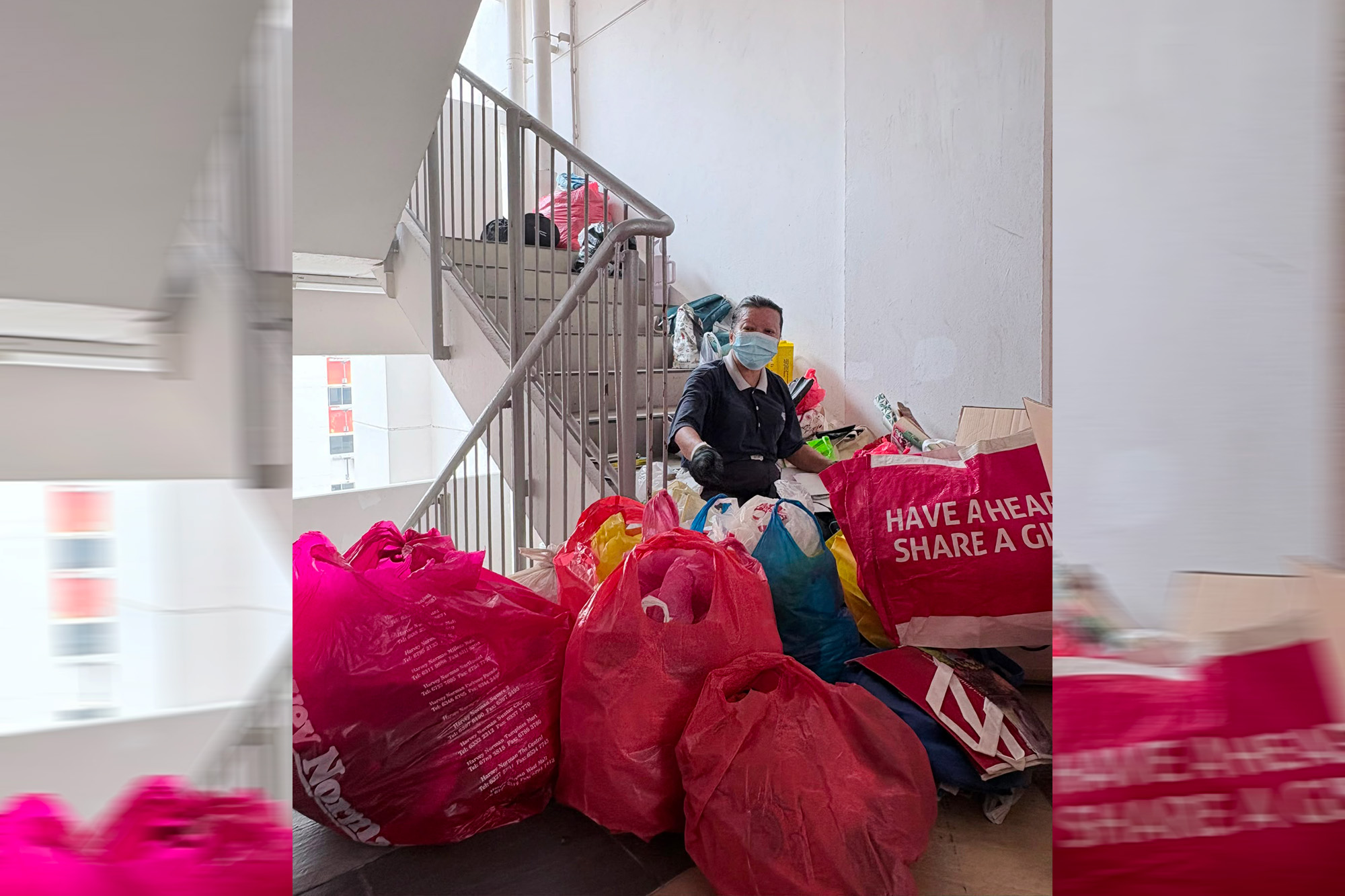
Tzu Chi provides care for people with hoarding behaviour under their Home Improvement Programme. The photo above depicts a home assessed as having a Level 9 hoarding situation. (Photo by Tong Ler Yee)
“We were literally climbing a mountain”, described Jennifer Yeep, a volunteer involved in providing support to individuals with hoarding behaviours, as she recalled the scene she was met with upon entering the homes of hoarders. As a result, the volunteers then had to climb in from the door.
Everywhere you looked, piles of clutter could be seen covering levels one and two. Even the stairs did not have a single space to set foot on. Jennifer shared that this was the reality of a residence whose hoarding situation had been rated Level 9.
“I was very shocked. Although I had seen news reports about hoarding disorders previously, seeing it with my own eyes still came as a huge shock!” exclaimed Jennifer as she related her first encounter with a hoarding case.
Faced with the mountains of items, volunteers still had to ask the individuals concerned to check if they were willing to discard each item, even when it came to expired food. However, to the homeowners, there was a reason to keep everything. This kind of inability to let go of anything is a common trait among hoarders.
A ‘Marathon’ with No End in Sight
Hoarding disorder is a complex mental illness characterised by an inability to discard or part with one’s possessions, leading to a cluttered and congested living space. Most sufferers also frequently collect or pick up items deemed useless or worthless by others. Currently, the causes of this disorder are still not fully understood by the academic community.
Severe hoarding not only negatively impacts daily functioning and interpersonal relationships of sufferers and those around them but also pose safety hazards from falling items, pest infestations and fire risks. The International Obsessive-Compulsive Disorder Foundation (IOCDF) uses the Clutter Image Rating Scale (CIR) to visually assess the hoarding situation with a rating of one to nine, with one being the least severe and nine being the most severe.
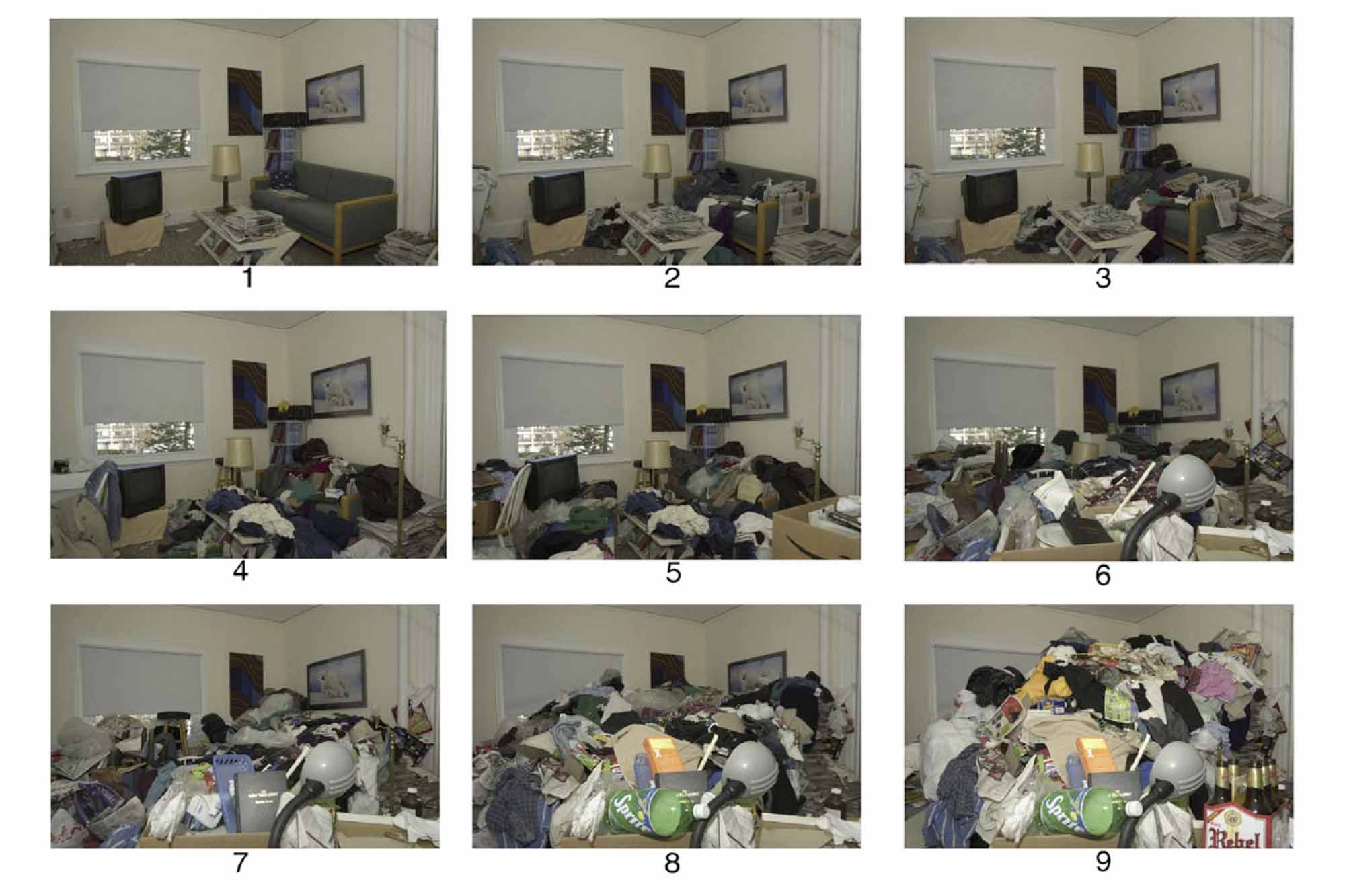
A diagram illustrating the CIR. (Image source: IOCDF website)
In January 2025, Tzu-Chi Foundation (Singapore) was invited to join the New Environment Action Team (NEAT). Through integrating resources and sharing expertise, this alliance enhances efforts in tackling hoarding cases. Through promoting early identification and intervention amongst families and communities, it ultimately serves to improve the living condition and behaviours of people who hoard.
Since joining NEAT, Tzu Chi has taken on nine hoarding cases, five of which are still being followed up. Tong Ler Yee, a staff of Tzu Chi’s Charity Development Department stated that currently, most cases come as referrals from NEAT or other external organisations. After receiving a referral, the staff and volunteer team then jointly assess the case before deciding whether to accept it. The assessment includes the individual’s willingness to cooperate as well as whether the volunteer team has sufficient manpower and capacity to provide long-term care. Additionally, the Charity Development Department also conducts online training on caring for hoarders and provides hands-on experience through mentoring to provide volunteers with practical learning experiences.
Loo Soon Huat, who volunteers with the hoarding support programme and has six years of home cleaning experience, explained, “The biggest difference between home cleaning and hoarding cases lies in whether both parties have a common goal.” As such, home cleaning is often completed within a few days while for hoarding cases, even after spending lots of time communicating with the other party, the cleaning process might not be completed smoothly.
Soon Huat recalled that the first hoarding case he encountered involved helping an elderly resident who was living alone to clean up his living space. At that time, the elderly’s hoarding symptoms were relatively mild and he was cooperative, allowing the cleanup to be completed successfully. However, the Level 9 hoarding case mentioned at the beginning was a completely different experience. Soon Huat, Jennifer and their team followed up closely on this case for about a year and a half but ultimately closed the case without successfully completing the cleanup due to various reasons.
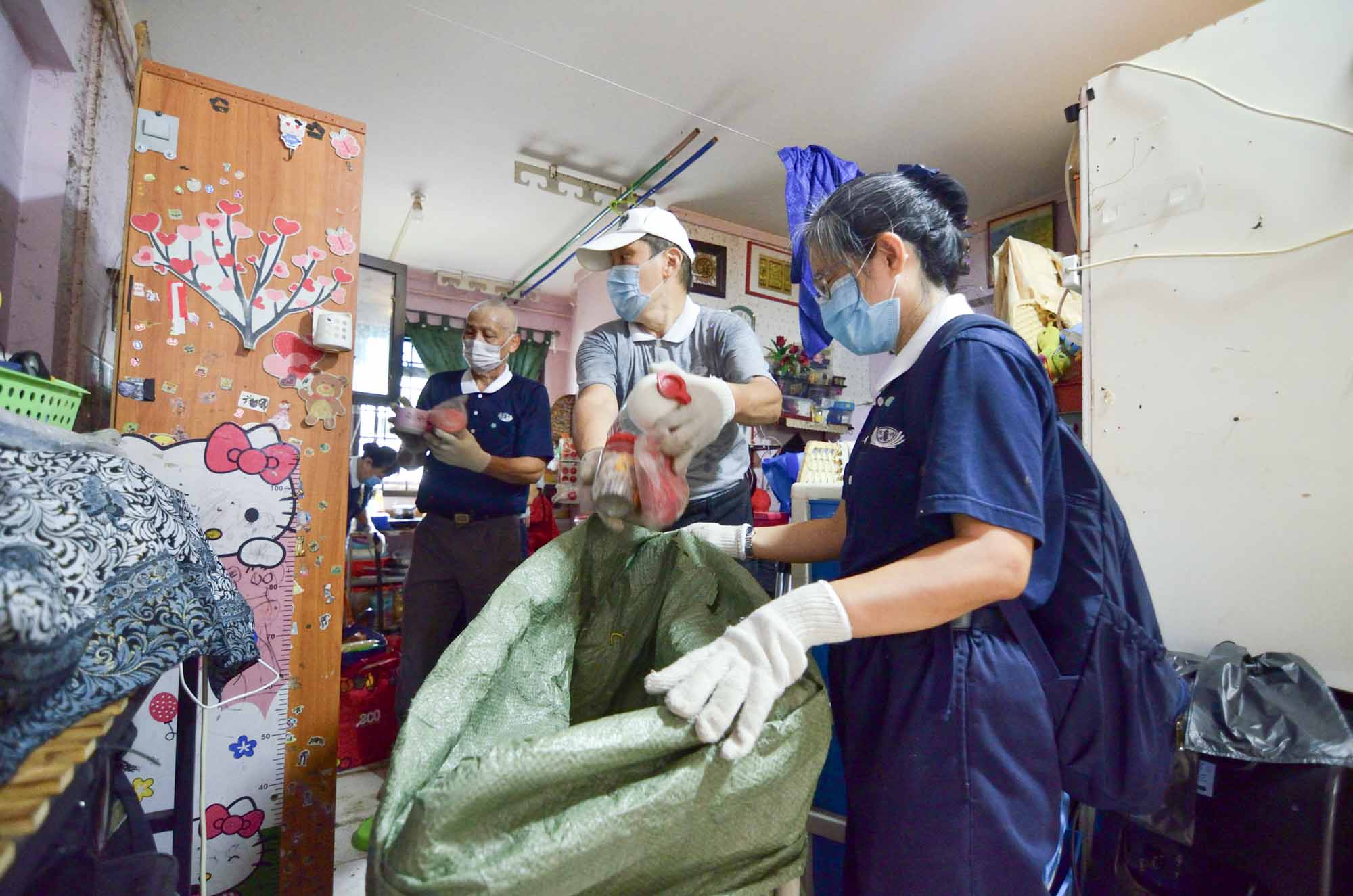
Home cleaning requires efficiency, where multiple volunteers are mobilised at once while hoarding cases typically mobilise only three to six volunteers, as it demands more patience and companionship instead. The photograph shows volunteers assisting a family with home cleaning. (Photo by Bong Kian Hin)
“We felt like it was a case of taking one step forward and two steps back.” Jennifer recalled when sharing about a case, explaining that volunteers would help to clean up once or twice a month but the person involved would continue to bring back items from outside to hoard. The spaces they had cleaned up would then be filled with clutter once again. “The person involved knew that the neighbours were complaining and that hoarding was not right. He also knew that there were people who cared for him, but he simply could not bear to throw his items away.”
Furthermore, the individual would frequently make calls to berate the team, questioning why the volunteers had discarded his items without consent. In reality, most of these items had been organised and stored into boxes by the volunteers, while other items were things that the volunteers had not even seen before.
After more than a year of cleaning, volunteers had only managed to clear out a single passageway from the doorway to the kitchen, stairs and room while the rest of the space remained filled with clutter.
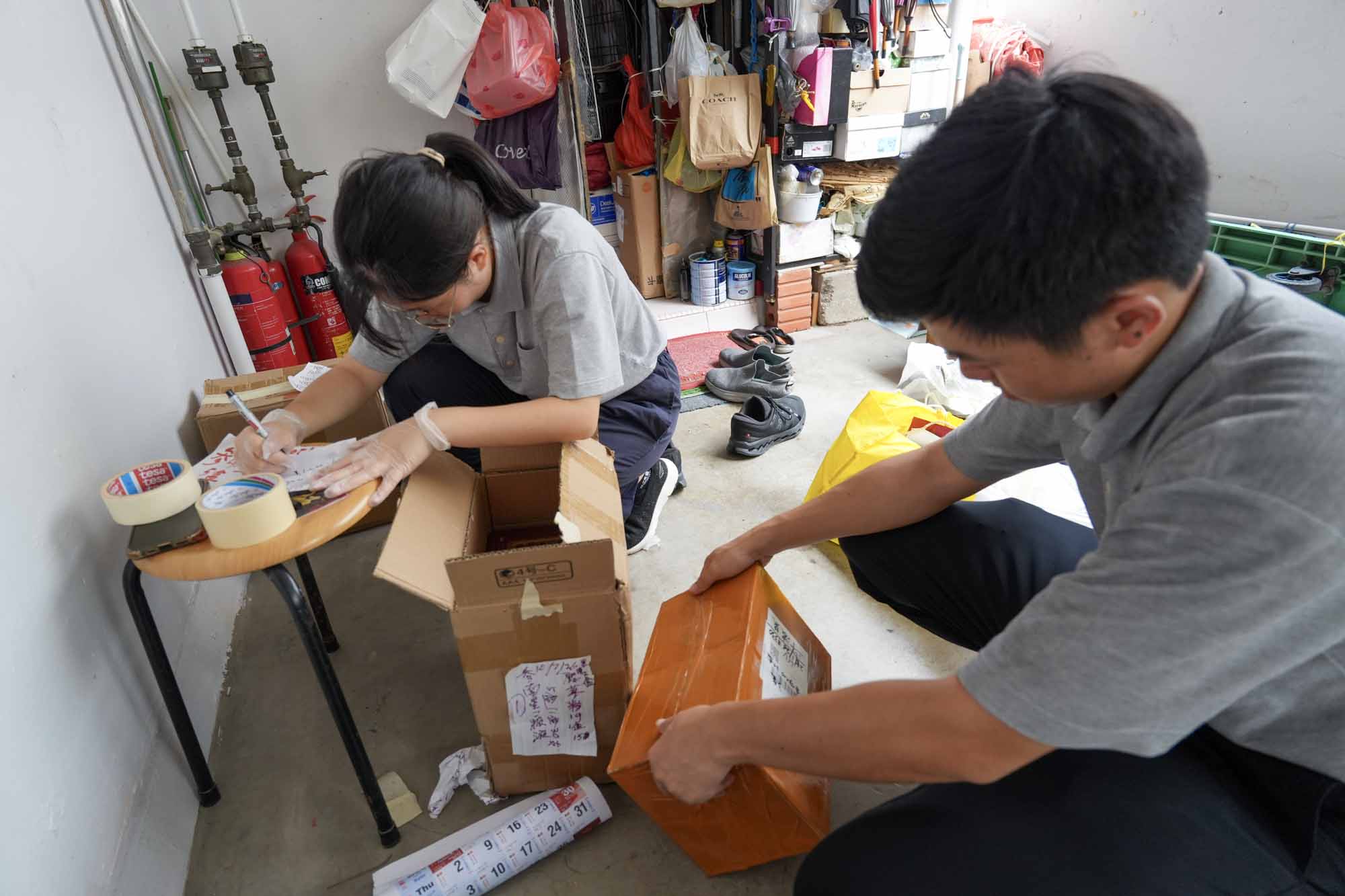 Volunteers sorting out items that the individual wished to discard, while categorising and packing items that could not be disposed of. (Photo by Teh Peng Yeng)
When progress falls short of expectations, volunteers inevitably experience negative emotions like grievance, disappointment and discouragement. Jennifer shared that she would then remind herself of the ‘Four Spiritual Soup’ advocated by Master Cheng Yen, which revolved around being “content, grateful, understanding and tolerant”.
“I have seen a particular case where the team responsible spent a total of seven years persuading the individual to renovate the house. Perhaps we did not have enough time, even after more than a year.” Jennifer also added, “As the individual was not ready, we decided to take a step back. We can always come back to him when the opportunity arises.”
Soon Huat also shared similar insights regarding providing companionship to people who hoard. He said, “If someone has been smoking for decades, you cannot expect them to quit overnight just by telling them to stop.” Hoarding is essentially the same. It is a long-standing habit that often masks underlying feelings of insecurity and other psychological factors. As such, it is even more crucial for volunteers to provide patient and empathetic companionship while learning to accept the individual’s emotions.
Clearing the House Does Not Always Solve the Problem
“Why can’t we just clear it all out at once?” “Why is there still no progress after so long?” These are some of the common questions that come into the minds of new volunteers who take up hoarding cases.
Phay Lay Leng, a fellow volunteer, shared that she had once witnessed a charity organisation clear out the home of a hoarder in one go. Unexpectedly, after seeing the clean house, the individual suddenly started screaming loudly and lost control of his emotions. This scene made Lay Leng realise that seemingly efficient cleaning methods were actually not friendly to hoarders. “We need to understand that this is a mental health condition, and then learn how to treat them.”
 The time required for each cleanup varies, and whether it will proceed smoothly cannot be guaranteed. Volunteers need to adjust their approach based on the individual’s mood and state of mind. The photo shows Lay Leng helping with cleanup in a hoarding case. (Photo by Chen Pei Chi)
Today, the volunteers are no longer fixated on how much should be cleared out each day. Rather, they have learnt to slow down and move at the pace of the individuals. Currently, Lay Leng has been following up with a Level 9 case for over a year. Before the cleaning process, she spent six months building a trusting relationship with the individual. She anticipates that this case will require another two to three years of follow up.
“We should not expect to clean out the entire house in a year.” Lay Leng said. “These ‘deposits of love’ are especially important, requiring patience and time.”
Seeing one’s Connections with Material Items through Volunteering
Through her interactions with hoarding cases, Lay Leng started to notice when the people around her exhibited symptoms of hoarding disorder. At the same time, she also started reflecting on her emotional attachment to material items. She found that people often cling to items that they bought with their own money even when they are no longer needed, leading to the items piling up over time. “When I organise my own things, I usually give myself a period of three years. If an item is not used during that timeframe, then I will throw it away.” However, she still chooses to keep items with special sentimental value while also reminding herself to buy only what she needs.
Decluttering is a skill that Jennifer gained from volunteering with hoarding cases. She shared an example of how she used to keep clothes that were too tight, thinking that she could wear them again after she slimmed down. Now, she chooses to donate unwanted clothing and items that are still in good condition to those in need. “After cleaning up, I feel better, and giving those items to people in need makes me feel good too.”
Jennifer admitted frankly that the items she still cannot bear to part with for now include souvenirs given to her by others. “If someone buys you a gift from abroad and you do not accept it, it makes you feel bad.” As such, striking a good balance between appreciating others’ good intentions while reducing unnecessary items is still a work in progress for her.

Soon Huat stated that most people are reluctant to discard some things, but they are still able to gauge when an item has lost its value and needs to be discarded. (Photo by Fong Kwai Kin)
Beyond her reflections regarding material items, Jennifer also realised the importance of accepting help from others. Sometimes, people are happy to help others but are not used to accepting themselves. “When we encounter difficulties and someone comes to our aid, we should work with them and know that they come with good intentions. Many times, we do not even realise that we actually need help.”
While cleaning up the homes of hoarders, volunteers were able to re-examine their own consumption habits and attitudes towards life. As Soon Huat mentioned, in an era where shopping is becoming increasingly convenient, people need to understand what they truly need, whether in terms of material items or otherwise. “It is good to have just enough things, as the most important aspect is still our health. Don't be too fixated on things in life; learn to let go.”
Share 


